
Human Resources Strategy
Language switcher
June 2026
When people change, the company changes.
Building on five years of accelerating transformation, we are forging our next growth strategy

Director & Senior Vice President
In charge of Group General Administration & Human Resources Management, Group Legal and Intellectual Property,
Group Logistics and Secretarial Office
Minoru Mizoguchi
In our Long-Term Management Objectives (2021-2025), an accelerated human resources strategy created a virtuous cycle that drove us to record profits. Looking ahead, we urgently need structural transformation to speed up productivity improvement further as we anticipate a declining workforce. In our Long-Term Management Objectives (2026-2030), we aim to achieve sustainable growth by evolving into an organization where diverse human resources continuously create high-value outcomes — anchored in "SHIN Lifetime Employment (SHIN means both "New" and "True" in Japanese)," a new concept that synchronizes individual and organizational growth.
Our Human Resources Strategy Drove Record Profits
The greatest achievement of our human resources strategy under the Long-Term Management Objectives (2021-2025) was creating an "engagement improvement cycle" that aligned our business and human resources strategies at an unprecedented pace. This strong alignment drove five consecutive fiscal years of revenue and profit growth.
Looking back over these five years, the single factor that drove a virtuous cycle in our management was, in a word, speed. Our frontline employees had long understood the need for change, but the speed with which we translated that understanding into action had been a challenge. The dramatic increase in our execution speed over the past several years drove the major transformation and results we have achieved.
A prime example is how we responded during the COVID-19 pandemic. Resolved to "turn crisis into opportunity," we rapidly promoted remote work and workstyle reforms. Changes that would ordinarily have taken years to embed became standard practice in a short period. As a result, overtime hours fell sharply. To this day, our offices go dark at 8 p.m. What matters here is not simply cutting costs, but a shift in mindset toward asking how we can create added value within a limited timeframe. This dramatic shift in how we think about time laid the groundwork for the next step, transforming our business structure.
Building on that groundwork, we turned to transforming the people who drive our strategy. As we aim to shift toward the IT solutions business and to transform our business portfolio, we cannot succeed without change at the operational level. What mattered most over these five years was not so much acquiring external personnel, but as to how much our existing employees were able to change. M&A and specialist personnel are effective near-term measures, but they alone cannot address underlying challenges. The real significance lies in each employee independently changing how they work and how they create value.
Listening to employee presentations during last year's employee commendation system reviews convinced me that this transformation is real. The presentations have shifted markedly ̶ from "how many devices did we sell" to "what value did we deliver to customers, with what story." The quality and perspective of the proposals had also improved. It was a moment that convinced me that the development of skilled personnel is genuinely driving business growth.
The Human Resources Strategy Committee has been the driving force behind this transformation. The president, directors, and business managers have met every two months without fail to discuss human resources issues directly as a top management priority. This forum has kept discussions from remaining abstract and enabled us to act swiftly on concrete measures such as reskilling of all employees. As a result, more than 1,400 professional personnel have been developed through programs such as the DX certification system, and we have built a solid foundation to support our next phase of growth.
A Sudden Workforce Shortage Arising from the Company-specific Age Composition
On the other hand, there are issues that have been left unresolved over the past five years. On top of the structural challenge of a declining working-age population across Japan, we face a company-specific issue of a skewed age distribution in our workforce. We have a large number of employees approaching retirement age, while the ranks of employees in their late thirties to early forties are thin — a result of hiring restraints during the global financial crisis and its aftermath. In short, we expect that by around 2030 a genuine management challenge will emerge. A large wave of experienced employees will leave the front line, with too few mid-career professionals to fill the core roles they leave behind.
Since a decline in headcount is unavoidable, we must change how we work, starting now. When speed becomes the key to raising productivity in that environment, we recognize that we are not yet where we need to be. I have long urged our people to think as if we need to run the business with half the headcount. The goal is not to do the work of 10 people with nine or eight. We need to redesign our processes from the ground up so that we can handle them with half the headcount.
The key to achieving this is increasing the number of tasks we can avoid doing. We will delegate to IT what can be digitalized, entrust to outside parties what can be outsourced, and fundamentally overhaul our business processes themselves. Relying solely on the effort of workers on the front line has its limits. We believe that acting before those limits are reached is our greatest challenge for the next five years.
SHIN Lifetime Employment : A Cycle of Resonance and Growth beyond the One-sizefits-all Model
At the heart of our human capital enhancement for the Long-Term Management Objectives (2026-2030) lies an enduring belief that acquiring and retaining human resources is the lifeblood of our business. Our answer to this question is the concept of SHIN Lifetime Employment.
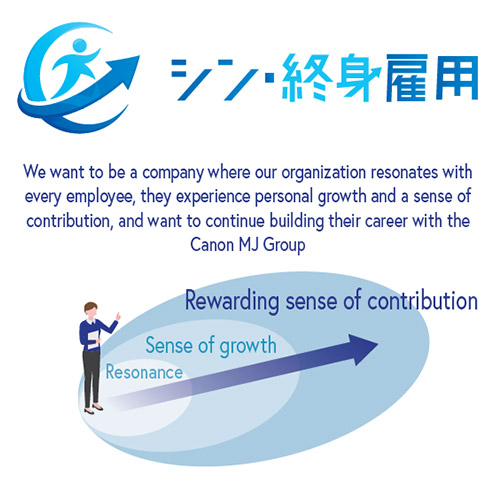
Every employee who joins the Company has chosen to do so because something here ̶ our business, our people, or our culture resonates with them. We want each employee to build on that important sense of resonance as their starting point, accumulating a sense of growth and contribution through their dayto-day work. Rather than the old model of lifetime employment, in which the Company unilaterally guaranteed job security, we want employees to feel that working here is genuinely meaningful to their lives, and to stay with us as a result. I define this as "SHIN Lifetime Employment," meaning lifetime employment that emerges as a result. This applies not only to new graduates, but equally to professionals who join us through mid-career recruitment. We have a responsibility to provide the opportunities and structures that enable them to keep taking on new challenges.
As part of that effort, we are fundamentally strengthening our mechanisms for internal mobility. In addition to "JOBS (Job Opening Bulletin System)," our in-house recruiting program through which employees volunteer for roles, we operate an "FA (Free Agent) system" that allows employees with FA rights to indicate their intentions with respect to their career and the type of job they wish to take on and be transferred to a division when a suitable position is found for them. Last year, we also launched new initiatives to promote cross-divisional transfers. Keeping human resources fluid and placing people where they fit best does more than prevent organizational stagnation. It is essential to maximize each individual's drive to take on new challenges.
This alignment of individual ambition with opportunity applies not only to existing employees, but also to professional personnel joining from outside and to colleagues who have become part of our team through M&A. They join us because they share our vision for transformation and seek the best stage on which to apply their expertise. In launching new businesses, personnel with outstanding expertise from different fields apply their capabilities to the full, dramatically accelerating the pace of commercialization. Connecting this "professional passion"̶ from inside and outside the Company alike ̶ swiftly to the right strategic opportunities is what will drive our next phase of growth.
Development of Engagement Improvement Cycle The "Power of People" Driving ITS toward ¥500.0 billion
Only when individual passion aligns with opportunities for challenge does our "engagement improvement cycle," which is the engine of our growth, begins turning at a higher level.
The key to accelerating this cycle is synchronizing the Company's growth with the growth of each individual. I have consistently communicated that the company will give its full support to any individual growth that contributes to the company's growth. We concentrate investments in human resources on areas where our strategic direction and individuals' growth and contribution align. This is our fundamental stance. At the same time, our organizational culture places strong emphasis on fostering psychological safety. We encourage open, flat dialogue between managers and their teams, welcoming diverse perspectives. Once a decision is made, everyone commits to it fully. Only with a culture that eliminates the kind of stagnation in which people quietly resist a decision once it has been made and that moves everyone forward together can individual growth translate into collective momentum.
In the years ahead, the source of value will shift entirely from products themselves to people. In the era when we sold devices, the products themselves held the value. Today, however, we provide solutions, and the knowledge provided by people, reasoning, and the trust our people earn from customers are the foundation of our business. That is precisely why we must in-vest in our people as a company and raise each individual's market value.
Growing our IT solutions business to approximately ¥500.0 billion by 2030 will require more than superior technology alone. We need highly skilled personnel who can translate that technology into customer value, articulate it clearly, and guide clients through to implementation. In last year's employee recognition program, many of our people presented compelling stories about providing value to customers, rather than simply reporting sales results. Accelerating this skilled personnel development further, and connecting individual growth directly to business growth will be important. This is the heart of our human resources strategy and the most critical theme shaping our future.
Uniting Diverse Human Resources to Forge the Future through Collective Strength
Our greatest human capital strength is the ability to assess reality with clear eyes and adapt flexibly to environmental change. Underpinning that ability is a culture of genuine diligence. In fact, actual assessment results for our managers confirm this: scores for "drive toward accomplishing tasks" and "planning and management capability" stand out as markedly higher than at peer companies. This reflects an exceptionally strong collective strength in uniting behind defined targets and driving toward them. At the same time, this very diligence is the flip side of issues such as a psychological difficulty in eliminating existing work, and the fact that capabilities tied to innovation such as "problem identification" and "issue generation" are relatively low.
I think that human resources strategies are ongoing endeavors. Sustaining long-term growth requires a company to keep transforming itself in step with changing times and evolving business strategies. Developing the people who drive that transformation is a never-ending endeavor. The era of blind faith in a single business model is over. We now need to attract diverse human resources from inside and outside the company such as human resources suited to our IT solutions business, new ventures, and other emerging pillars, and bring them together.
The organization we aspire to build does not rely on exceptional individuals. Instead, it maximizes collective strength a structure where each person brings — distinct strengths and expertise, and managers effectively unite those contributions toward a shared direction. We will continue to embrace change and pursue challenges as we aim to build a company where externally recruited specialists and our core internal human resources exchange candid views across their differences and keep searching for better ways forward.
![The Relationship between the Company and its Employees under SHIN Lifetime Employment Trust-based relationships Opportunities to thrive/Growth support Motivated work performance ompany Business growth Employees Improving our capabilities Achieving our management vision Increasing our corporate value Company and employees as equal partners(Fair evaluation based on merit) A sense of unity through mutual connection [The engagement we aim for is a relationship of mutual trust between the company and its employees.]](/-/media/Project/Canon/CanonJP/Corporate/ir/library/integrated-report/hr-strategy/image/companyandemployees-en.jpg?h=330&iar=0&w=800&sc_lang=en&hash=DF78467129EC435B8D8ADEA18E48EC84)
Continuously Developing the True Professionals Chosen by Our Customers
In the years ahead, it will be essential for each of our employees to keep sharpening their individual value through the power of people and technologies. Unlike the device-centric era of the past, today's environ-ment demands IT solutions and the resolution of social issues. What matters now is not a person's title or position, but the value they can deliver to customers.
When delivering intangible solutions, the personnel who can earn customers' trust and confidence with the sense that "this person can solve our problem" are the Company's true source of value. Over the past five years, we have steadily developed personnel who can take on our customers' complex operations end-toend and deliver high added value.
We will continue to invest in developing these personnel without any compromise. We aim to build a team of true professionals who can persuade customers through technical knowledge and logical reasoning, rather than relying on willpower or grit. We are confident that this will further elevate us on the path toward 2030.
-
*
The content of this page is based on information at the issuance of the integrated report.