
Risk and Crisis Management
Language switcher
Basic Approach
The Canon Marketing Japan Group (hereinafter the "Canon MJ Group") has divided its crisis management activities into two categories, risk management activities, which are preventive measures, and crisis management activities, which are responses to crises that have occurred.
While they are both components of crisis management, their purpose and phase of response are different. Accordingly, we have established measures with structures tailored for each of them, and we are moving forward with initiatives to ensure the stability and continuity of our corporate activities.
Risk Management (Preventive Measures)
The goal of these initiatives is to prevent critical situations by proactively identifying and assessing the various risks that could occur in our corporate activities.
Target: Predictable risks
Purpose: Prevention of occurrence and examination of countermeasures
Major activities: Risk assessment, development of rules, training, awareness-raising activities, etc.
Crisis Management (Handling of Crises That Have Occurred)
The goal of these initiatives is to prevent the expansion of serious crises that could threaten the continuity of corporate activities or the survival of the company and minimize damage.
Target: Sudden serious crises
Purpose: Prevent the expansion of crises and minimize damage from them (preserve the continuity of corporate activities, quickly resume activities, etc.)
Major activities: Formulation of response policies, including initial responses, business continuity and resumption plans, training, etc.
Structure
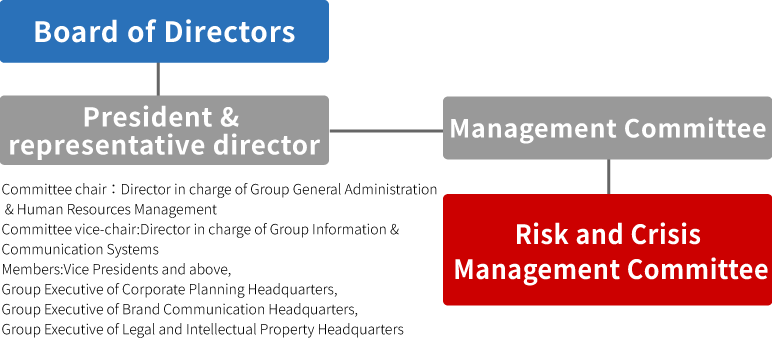
We have established a Risk and Crisis Management Committee, its chairperson is the Director and Senior Vice President (responsible for the Group's human resources and general affairs), for the purpose of building and implementing risk management systems and crisis management systems in order to improve corporate value of the Canon Marketing Japan Group (hereafter, the "Canon MJ Group") and minimize loss for our stakeholders.
The Risk and Crisis Management Committee was established as a body separate from the Audit & Supervisory Board, and the Director and Senior Vice President, who chairs the Risk and Crisis Management Committee, is not a member of the Audit & Supervisory Board.
The Risk and Crisis Management Committee is held four times per year. It was held in January, April, August, and November.
Initiatives
Areas of Activities of the Risk and Crisis Management Committee
-
Preparation and set up of risk management systems
-
Preparation and set up of crisis management systems (including BCP)
-
Raising and promoting awareness of corporate ethics and compliance
-
Information security
-
Internal reporting response
Building and Establishing Risk Management Systems
Subordinate to the Risk and Crisis Management Committee, compliance departments are offices in the domain of risk management that assess risks company-wide in view of the potential damage they could cause, the severity of their impact, their frequency, their likelihood and other factors to identify and assess the risks that the Canon MJ Group may face in conducting its business each year, including the risks of violations of laws and regulations and information security risks.
They then establish risk management systems and formulate measures to address risks. We have been examining these risks to identify priority risks that are considered important and taking positive steps to address them in collaboration with related departments.
In addition, we carry out risk management activities in accordance with the annual activity plans that have been developed and approved by the Board of Directors.
We assess the state of development and operation of the risk management system and the Board of Directors checks its effectiveness every fiscal year. (Individual companies in the Group also report their findings to their respective boards of directors.)
These systems are based on the Risk and Crisis Management Regulations, which set forth the basic policy on risk and crisis management and the risk and crisis management systems of the entire Canon MJ Group.
In addition to these company-wide measures and the establishment of systems, we also identify risks in our daily contract evaluation, legal consultation, and other activities to prevent the occurrence of risk and take other actions, as a part of our efforts to build practical risk management and compliance systems.
Development and Establishment of Crisis Management Systems
Working under the Risk and Crisis Management Committee, the departments responsible for crisis management, which serve as the administrative offices for crisis management matters, assess the damage from and impact of sudden, serious risks such as natural disasters and work to establish crisis management systems to ensure a quick and appropriate response to crises. In addition, Canon MJ identifies operations that are important in the achievement of business continuity and the fast resumption of operations, and it formulates and reviews measures every year on an ongoing basis using a PDCA cycle in cooperation with related departments. As with risk management, these systems are developed and operated in conformity with the Risk and Crisis Management Regulations of the Canon MJ Group.
For more information about our business continuity activities, see Business Continuity.
Raising and Spreading Awareness of Corporate Ethics and Compliance
For us, compliance is not simply a matter of obeying laws and regulations. We also commit to complying with laws and social rules, maintaining social justice, and continuing to meet the expectations of society based on the spirit of integrity (being honest, sincere, and earnest). We engage in compliance from the perspectives of initiatives to raise awareness, educating, and undertaking organizational activities to ensure that all of our people act ethically and obey the law.
For information about specific compliance advancement measures, see Compliance.
Internal Reporting System
We have introduced and operate the Speak-up System, an internal reporting system, with the aim of ensuring the early detection of violations of laws, illegal acts, or matters contrary to corporate ethics related to business activities or business execution within the Group, and of taking corrective actions and preventing their recurrence.
For more information about the internal reporting system, see Compliance.