
Dialogue with Investors
Language switcher
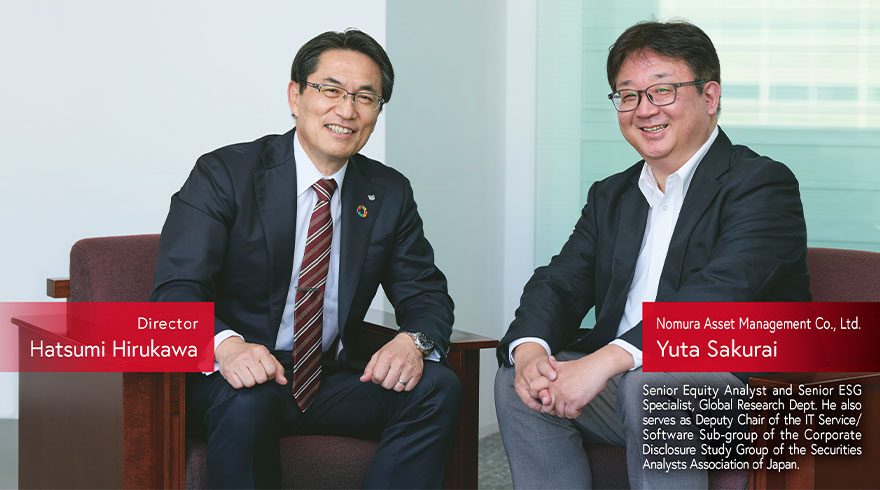
The Long-Term Management Objectives (2021-2025), which delivered strong results, have now concluded, and the new Long-Term Management Objectives (2026-2030) have begun. As the Group makes a significant shift in its strategy to focus on the IT solutions business, how do investors evaluate the Group? We invited Mr. Yuta Sakurai of Nomura Asset Management Co., Ltd., and Hatsumi Hirukawa, our director in charge of IR, asked him about the Group's performance from an investor's perspective and his expectations for future growth, particularly for the IT solutions business.
Evaluation of the Long-Term Management Objectives (2021-2025) and the Group's Strengths
Hirukawa : The Group has completed its Long-Term Management Objectives (2021-2025) (the "21-25 Long-Term Objectives"). In the 21-25 Long-Term Objectives, we presented growth strategies for both the Canon products business and the IT solutions business. Because the Canon products business operates in a mature market, we pursued a strategy to improve profitability. On the other hand, for the IT solutions business we recognized that IT investment aimed at improving productivity would expand amid Japan's declining birthrate and aging population, and accordingly positioned it as a growth area in which we would actively invest. However, rather than simply riding the wave of corporate IT investment, we moved away from our previous broad approach to business development and concentrated our resources on specific areas where we could provide deep value to our diverse customer base. Instead of competing head-on with large-scale mission-critical system construction projects for large corporations, we chose to leverage our strength in engaging closely with a wide range of customers, ranging from large corporations and quasi-major and upper-medium-sized enterprises to small and mediumsized enterprises. Clearly reflecting this approach in our business portfolio was a major achievement that contributed to our future. A sense of confidence is gradually being fostered in our organization as we build on each of these efforts. There is a significant difference in organizational drive and unity between a team that believes in the direction of its initiatives and focuses on steadily doing the right thing, and one that proceeds with doubt and uncertainty. We recognize that the past five years have been a period in which we were able to solidly build this organizational foundation.
Mr. Sakurai has followed the Group for many years and has maintained ongoing dialogue with us through individual meetings during the period of the21-25 Long-Term Objectives. What is your honest assessment from an investor's perspective?
Sakurai : As Mr. Hirukawa just mentioned, the 21-25 Long-Term Objectives delivered strong results, including five consecutive years of revenue and profit growth, and I evaluate this very positively. Despite the extraordinary circumstances of the COVID-19 pandemic, the Group significantly improved its profit margins compared to industry peers.
I believe that management's decisive efforts in the selection and concentration of management resources led to the outperformance of the IT solutions business in terms of sales growth and a significant improvement in profitability. The experience of overcoming a difficult environment itself beyond simply achieving financial targets has become a major source of confidence for the organization. In addition to these quantitative results, I also feel that the Company has made steady progress over the past five years in strengthening its management foundation, including governance. What do you see as the challenges ahead for sustainable growth?
Hirukawa : Going forward, we must further improve the profitability of both business portfolios. Net sales in the IT solutions business exceeded ¥340.0 billion, accounting for 51% of total sales. Although profitability has improved, it has not yet reached the level of the Canon products business. We believe it is important to clearly define our unique strengths and deliver them quickly to the customers who can benefit most from them in order to enhance our earnings power. Generative AI is also an essential topic for our future business development. We believe that advancing the internal utilization of generative AI and, more importantly, linking it to the value creation for our external customers with a strong sense of urgency will be a key driver for our sustainable growth.
Sakurai : Over the past five years, the IT services industry has seen a number of drivers that have boosted demand, such as mission-critical system renewals, standardization of local government systems, and the electrification of automobiles. I believe that Canon MJ has successfully captured these opportunities. On the other hand, to put it a little harshly, when asked what Canon MJ's strengths are as an information services company, I feel that the answer is not entirely clear in some respects. That said, there is no doubt that steadily strengthening what the Company can do and growing the areas which it has strengths in have led to strong performance, and I highly evaluate this.
Hirukawa : To be honest, we recognize that there are still only a limited number of areas where we can say we are the overwhelming number one. One of the Company's characteristics is that we serve a broad customer base, ranging from large corporations and quasi-major and upper-medium-sized enterprises to small and mediumsized enterprises. While many companies focus on specific customer segments, we feel that this breadth is both a distinctive feature of the Company and one of the reasons why it can be difficult for external parties to clearly identify where our greatest strength lies. This diversified strategy, covering everything from large corporations to small and medium-sized enterprises, also serves as a risk hedge, allowing stronger areas to compensate when others are weaker. We do not intend to significantly change this strategy in the future.
Sakurai : Certainly, the fact that the Company serves the full spectrum of customers is a major strength. Within that broad scope, however, the key lies in making the most of limited management resources and capabilities, identifying what the Company can do, and delivering maximum performance. In other words, the discipline of not doing what is not to be done and refraining from stepping into what should not be ventured into is what ultimately drives competitiveness. Another point I highly evaluate is the significant progress in governance. This includes resolving the issue of short-term loans to the parent company and reviewing the composition of the Board of Directors, and I believe these five years represented major progress in the direction that we investors consider desirable for management.
Hirukawa : We are very pleased to receive such recognition, as strengthening governance has been a conscious effort of our management. Since 2015, the Group has been working to transform itself into a more robust management structure, and the results of these efforts have progressed faster than initially anticipated. Looking back, we recognize that we accumulated a considerable amount of funds and that internal reserves had become somewhat excessive. In light of this situation, the Board of Directors carefully considered whether to allocate these funds to shareholder returns or growth investments, and then executed accordingly. We are very grateful for the recognition we have received for the steady progress we have made while carefully coordinating with our parent company, including our approach to investments and the establishment of our corporate venture capital arm.
Highlights of the New Long-Term Management Objectives and the Current Status of Business Model Transformation
Sakurai : You have now announced the new Long-Term Management Objectives (2026-2030) (the "26-30 Long-Term Objectives") and Medium-Term Management Plan. What has changed from before, and what remains the same?
Hirukawa : In the 21-25 Long-Term Objectives, we positioned operating income as the top management indicator to clearly emphasize a profit-oriented approach.
In the 26-30 Long-Term Objectives, we have organized the management indicators in the following order: net sales, operating income, ROE, and IT solutions net sales. We must pursue a structure that grows revenue while also raising profitability, otherwise sound corporate growth cannot be expected. We believe that clearly highlighting this point is one of the major features of the 26-30 Long-Term Objectives. Although it may appear somewhat conservative, we have steadily built up, step by step, a discipline of doing what needs to be done and stopping what should be stopped. In addition to this, we must aggressively pursue M&A to further increase the Group's strengths going forward. We plan to generate approximately ¥300.0 billion in operating cash flow over the next five years, and we believe it is important to steadily direct these funds toward growth investments to acquire new strengths and unique capabilities.
Sakurai : I see that the base of the 26-30 Long-Term Objectives is the growth of service-type businesses. Is it correct to understand that this is basically a further strengthening of existing initiatives? How do you distinguish between new initiatives and the reinforcement of existing measures?
Hirukawa : We believe it is important to rapidly and significantly expand in the areas we confirmed as strengths in the latter half of the 21-25 Long-Term Objectives. For example, we expect continued growth in demand for the BPS (Business Process Services) area, the Group's focus area, and we intend to prioritize its growth. The other area is infrastructure, including IT platforms and cybersecurity, where Canon ITS has strong capabilities. Both areas are positioned to accelerate growth by reliably generating synergies with businesses we have already incorporated. Furthermore, we expect generative AI to become a major theme, particularly in the latter half of the 26-30 Long-Term Objectives.
Sakurai : As with the 21-25 Long-Term Objectives, M&A continues to be an important keyword. I have been following Canon MJ for many years and feel that "M&A expert" is an apt description of it. You have selected companies that fit your scale, and while respecting their culture and strengths, created the appropriate chemistry. This seems to be one of Canon MJ's distinctive strengths. In fact, your past M&A activities have generally been successful, and I expect similar results going forward. I believe that the Company's positioning of M&A as part of its business-oriented growth strategy, rather than relying on hostile acquisitions, is appropriate.
Hirukawa : The Group has operated its business in a wide range of industries based on the fundamental stance of understanding its customers' needs even more deeply than they do themselves. We believe the deep industry insights gained from this approach support our M&A activities. Each business manager has become increasingly capable of identifying which companies play important roles in their respective industries and which companies can best demonstrate their strengths as part of the Group. This accumulated experience forms the foundation of our current M&A strategy.
Sakurai : I agree completely. In the case of Canon MJ, your consistent stance is to always consider opportunities from a business-oriented perspective, identify suitable partners, and avoid forcing relationships that do not fit. This approach makes it easier for the other party to feel a sense of alignment as well. My understanding is that you have not carried out any hostile takeovers to date.
Hirukawa : That is correct. We generally ask the management teams of acquired companies to continue leading their businesses. We do not replace management teams after the acquisition or send large numbers of personnel en masse from the parent company. We respect the other party's culture and values, generate new chemistry, and work toward a better form. I believe that this approach is not something we created ourselves but rather a tradition built by our predecessors. Another important factor is our deep understanding of our customers. Lacking this, it becomes difficult to see where the Group should concentrate its strengths. While exploring technology itself is certainly important, it is equally important to strive to understand our customers' operations and management issues even better than they do. This is another strength the Group has developed over many years, and we intend to further refine it going forward.
Sakurai : To slightly add to your point, rather than "cutting-edge technology," it may be more accurate to describe your strength as "technology that precisely addresses customers' management challenges."
Hirukawa : I agree completely. We believe that being half a step ahead rather than one step ahead is the right positioning for the Group. Rather than envisioning a distant future, we aim to stay closely engaged with customers on the field and focus on management issues that are likely to emerge over the near term. I feel that this attitude is the right style for our Company. Rather than striving to be edgy in a smart way, we would rather be a grounded presence that stays close to our customers and continues to accompany them over the long term. I believe that always being by the customer's side and staying closely engaged are the essence of our Company. We believe that without this stance, it would be difficult to realize the four focus areas set in the 26-30 Long-Term Objectives.
Sakurai : Many companies now are pursuing business model transformation and structural reform. They say they are shifting from contract development to service provision, from man-hour billing to value-based pricing, or from flow-type to stock-type models. However the shift is framed, these are all major trends and directionally correct. However, it is easier said than done, and ul t imately, the key to successful transformation lies in how compelling a solution a company can provide. Without that, it is difficult to build the kind of relationship in which customers feel comfortable entrusting their entire operations to you. In that sense, I believe the entry point for Canon MJ is to further refine and steadily strengthen these four focus areas.
How We View the ¥200.0 Billion Growth Investments
Hirukawa : The 26-30 Long-Term Objectives set out a plan for the Group to make ¥200.0 billion in growth investments over the next five years. How do you view this point?
Sakurai : I view positively the fact that this amount exceeds that of the 21-25 Long-Term Objectives. Allocating ¥200.0 billion of the planned ¥300.0 billion in operating cash flow to growth investments and the remaining ¥100.0 billion to shareholder returns, particularly dividends, represents a well-balanced allocation of resources overall. Although investors naturally prefer higher dividends, neglecting growth investments would negatively impact medium- to longterm corporate value. In that sense, the balanced approach between growth investment and shareholder returns is appropriate. A dividend payout ratio of 40% or higher is by no means low and feels appropriate. In addition, the fact that the investment framework is not rigidly broken down in advance, leaving room for flexible decision making, also suits the current state of the Company. However, this also means that greater accountability regarding investment outcomes will be expected going forward.
Hirukawa : Some may prefer flexibility like you, Mr. Sakurai, while others may want greater clarity. However, M&A in particular is influenced by timing and investment amounts, so it is not something that lends itself to overly detailed pre-allocation and looking back over the short term. I also feel that setting things too rigidly can slow down decision-making. Including the ¥160.0 billion in cash on hand, we believe it is important to make flexible decisions on M&A and acquisition of treasury stock, with the ultimate goal of driving the next stage of growth.
Sakurai : Rather than presenting a highly detailed plan in advance, I think it would be easier to understand if you showed actual results such as the investments made, roughly once a year. To be somewhat frank, I believe an explanation that clearly conveys "no shots have been wasted" tends to resonate more with investors.
Responding to Industry Consolidation and Technological Innovation
Hirukawa : In discussions of industry consolidation, there are different views on whether the emphasis should be on expanding scale or on creating chemistry, and the Group is clearly in the latter position. If pursuing only scale and holding on to excess assets is a risk, we believe it is more important to focus on initiatives that create new value through chemistry. Within the Group's business domains, we expect future M&A targets to include companies with technologies we do not yet possess or those with customer bases different from that of the Group.
Sakurai : I believe that the current industry consolidation is basically centered on pursuing economies of scale. Recently, general trading companies and telecommunications firms have also joined the consolidation framework. I don't want to sound rude, but there will likely be situations where competing purely on financial strength proves difficult, so I agree that exploring different approaches is necessary.
Hirukawa : In the B2B area, we do not expect in the foreseeable future a situation in which customers seek only a single service. In light of this, the key going forward will be how effectively we can increase the number of customers who become fans of the Group. To this end, it will be more important than ever to enhance our unique capabilities and steadily refine the value we provide. Responding to generative AI is also a topic we must address over the long term. While some tasks within SI and BPS carry a high risk of being replaced by generative AI, upstream processes in development such as system planning and conceptualization will continue to require human expertise. Currently, we believe that there is significant potential for generative AI to help control rising personnel costs.
The Group already has a low-code development tool called Web Performer that has helped improve productivity. Going forward, we will not only incorporate generative AI functions into Web Performer but also shift to a development process that assumes the use of generative AI. We believe this will lead to improved productivity and lower development costs as a result.
Sakurai : I often ask the same question of other companies I work with, and in many cases the response is that there will be no negative impact on near-term performance. Against this backdrop, I found it highly commendable that Canon MJ recognizes the risk of substitution by generative AI and has the view that risks from AI are not zero. At the same time, I will continue to keep a close eye on whether there is any relative delay in implementation speed compared with major competitors.
Growing Expectations for Transformation into an IT Solutions Company
Hirukawa : From an investor's perspective, how do you evaluate the Group's ongoing transformation into an IT solutions company? What kind of company do you expect the Group to evolve into going forward?
Sakurai : I have the impression that Canon MJ is relatively conservative and steady. Because of this, customer relationships are strong, and I get the sense that unprofitable projects that could significantly impact performance rarely occur. Conversely, this also means that the cost of taking on challenges is relatively low, but that in itself feels like a sign of steadiness.
Hirukawa : While we are a company that builds steadily step by step through close customer engagement, being steady should not mean being weak in the face of change or unwilling to take on challenges. However, if we continue to take on challenges with a low probability of success, the organization will eventually become exhausted. As management, we constantly think about how to accelerate the cycle of challenge and learning while ensuring that employees can see tangible results.
Sakurai : What I expect from Canon MJ is to establish overwhelming differentiation and brand recognition in specific areas where it possesses technologies and solutions that clearly sets it apart from competitors and allows it to demonstrate competitive superiority. It needs a specific area for which people can say, "When it comes to XX, we go to Canon MJ." I believe the Company is still only halfway there, so I hope these areas that symbolize the Company are further refined and strengthened. I look forward to seeing Canon MJ maintain its solid management foundation, while further enhancing the agility to respond swiftly to changes in the market environment.
-
*
The content of this page is based on information at the issuance of the integrated report.